
PRISON INSIGHTS’ 24: RESHAPE THE FUTURE
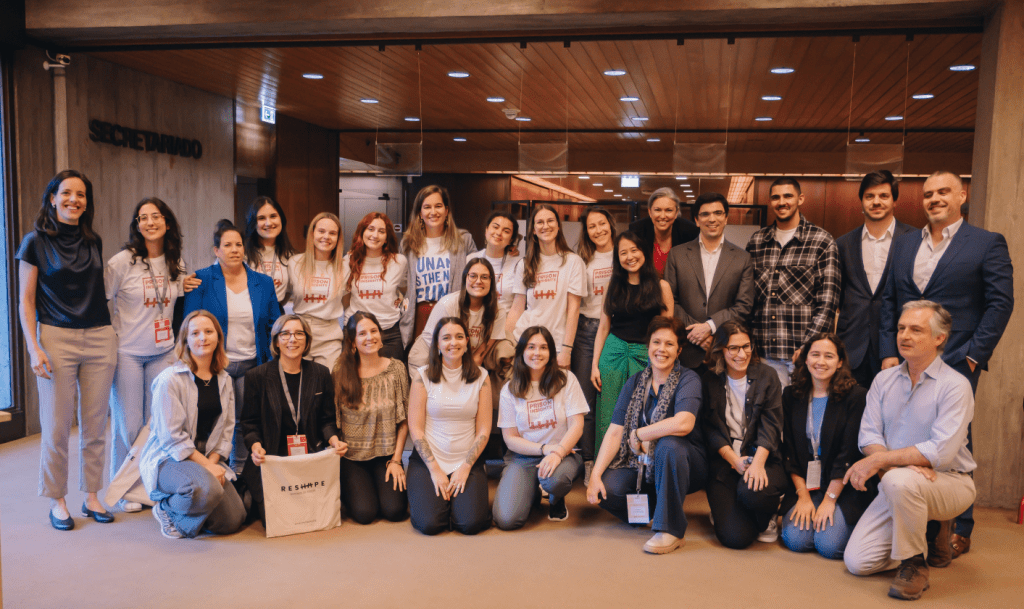
Last April, the main building of the Calouste Gulbenkian Foundation was filled with more than 400 enthusiastic attendees, eager to explore the past, present, and future of our prison systems. Lawyers, academics, students, policy makers, artists, and many others gathered for the 6th edition of Prison Insights. This day provided the perfect opportunity to reflect on prison systems. Attendees got to hear about moving and innovative projects from around the globe, all dedicated to humanizing the prison system and promoting effective social reintegration. Through engaging talks, roundtables, interviews, and photo exhibitions, the day was dedicated to #Reshaping the Future of our prison systems.
The day began with an insightful talk from Nina Champion, criminal justice consultant and co-director of a new social enterprise, Justice Futures in the UK, who discussed the hidden and profound challenges faced by those working to reform and reshape the justice system. Using the iceberg model, she illustrated that to change the justice system, we need to look beyond the surface. Much like an iceberg, the justice system encompasses deeper layers such as hidden policies, power dynamics, and perceptions that also need to be tackled. Using the RESCALED mission and work, which proposes small-scale, differentiated, and community-integrated “detention houses” as a new paradigm for the prison system, Nina showed how change can occur through paradigm shifts by addressing these deeper layers.
Leen Muylkens, who served as the Coordinator of Belgium’s first Transition House and is the director of the foundation De Kansenfabriek (The Opportunity Factory), which is about to open a transition house in Leuven, further elucidated us about this paradigm shift to small-scale detention. She spoke about her experience in setting up and administering transition houses within the Belgian context and shared her perspective as a psychologist when working with people incarcerated in large-scale facilities, a subject she addressed in her book “De Kansenfabriek – waarom ook gevangenen moeten kunnen dromen” (“The Opportunity Factory: Why Prisoners Should Also Be Able to Dream”).
Tamara Höfer also brought an important perspective on systemic change from the viewpoint of prison officers. Having worked as a prison officer in England and Wales, under the Unlocked Graduates Programme, Tamara gained powerful insights into the impact a good prison officer can make. She shared her experiences in leading change from within by redesigning prison walls to build trust. With her experience, she shared her road map for becoming an effective prison officer who serves society and encourages rehabilitation. Today, Tamara applies her knowledge in Austria, supporting systemic change particularly regarding prison staff.
Also warning us to look closely, Luciana Zaffalon presented JUSTA, a research, design, and impact centre in Brazil focused on criminal justice. JUSTA’s logo, a magnifying glass, symbolizes their mission to scrutinize public investments and private sector participation in the justice system. JUSTA aims to simplify available data and foster transparent discussions about where public funds are being directed, particularly in the justice system.
From all the way across the Atlantic Ocean, Jhody Polk and Christine ElDabh came to discuss the Jailhouse Lawyer Initiative (JLI) in the USA. This initiative uses legal education to empower incarcerated individuals with legal knowledge and contribute to breaking the cycle of incarceration. Jailhouse lawyers are incarcerated justice advocates, this is, individuals without a formal legal background who learn the law themselves to help with their own cases and those of their peers. Jhody, a jailhouse lawyer herself, provided insightful perspectives on how JLI, which she founded, is building a network of current and former jailhouse lawyers. They guide, teach, and support incarcerated people, promoting and equipping them with tools for personal legal empowerment but also motivate incarcerated and formerly incarcerated individuals to shape the law itself.
Perfectly timed to whet our appetites just before lunch, we “Cooked Up Change” with Michael Carter. He shared his inspiring journey from the North American prison system to becoming a Pizzaiolo and opening his own pizzeria. With his enthusiastic view on life and what it means to be a citizen in the USA after incarceration, Michael passionately spreads the message that by creating an environment where one’s past does not define their present and by providing the necessary tools for individuals to work on themselves, we can significantly promote social reintegration. Today, Michael, or better said Chef Mike, is the owner of Down North Pizza, a very successful pizzeria in Philadelphia. There, he serves dozens of people daily while employing previously incarcerated people, helping them in their journey towards successful rehabilitation. For the curious ones: I did ask Chef Mike if pineapple belongs on pizza. The expert’s answer was yes, it does, and he includes it in the menu (although he makes it extra fancy by caramelising the pineapple)!
After lunch, participants had the opportunity to choose from three simultaneous panels. One option was to learn about the daily life in the small-scale prison facility of Torres Novas, as well as the social media viral project UpFarming, which installs vertical farms, run by the inmates, in the same prison. In another room, participants could discover three innovative projects – Rubikon (Czechia), Working Chance (UK), and Yellow Ribbon (Singapore) – that work on employability of inmates and on how it promotes empowerment. In the third room, Fabian Sandoval, from the Norwegian non-profit WayBack dedicated to the social reintegration of inmates, discussed good practices implemented in Norwegian prisons. Regardless of the panel that participants chose to attend to, they were able to experience equally positive and important subjects.
As an energetic end to the day, a musical moment happened when music artist and activist Dino D’Santiago presented “De Dentro para Fora” (Inside out), a project carried out in Linho’s prison facility. This initiative helps several inmates channel their talent into producing music. Alongside the inmates, Dino and Professor Filipe assist in building and mastering beats, after which the inmates write lyrics and record songs and music videos. We were privileged enough to witness a debut of two songs that emerged from this collaboration.
Dino also shared with the audience a bit about the people involved in this project and their struggles around the logistics of musical production inside a prison facility. Since the inmates do not have access to a smartphone, a computer, or an iPad, they had to memorise the beats to the songs to work on the lyrics in the days after Dino and Filipe visit and until their next visit. This shows the deep impact that having a goal and a project to work on can have on individuals, whether incarcerated or not.
I had the amazing opportunity to volunteer and help organise this remarkable event. From the initial stages of searching for and contacting people willing to come to Portugal to discuss how their projects are changing the game for prison systems, to the final talk of the day, the entire experience was truly heartwarming and gratifying. I had the privilege to listen to and learn from so many brilliant minds that dedicate their careers to transform the prison system. One aspect that I found particularly striking was witnessing how people inspired each other throughout the day. I saw speakers chatting, exchanging ideas, and offering advice between themselves. Besides, as a young Portuguese citizen, it was motivating to see several Portuguese policymakers present, attentive, also being inspired by the projects presented.
I believe Prison Insights is much more than just an educational event – it is also a space for sharing, inspiration, and community building. The different perspectives and experiences shared by speakers and attendees created a vibrant and stimulating environment. For me personally, Prison Insights in 2022 was my gateway into the world of prison system reform and the concept of small-scale, community-integrated detention houses. This is proof of how the event fulfils its purpose of igniting the spark and starting conversation. The experiences and projects shared at Prison Insights demonstrate the potential our contributions, no matter how big or small, can have for transformative change, leaving us all inspired to reshape the future of our prison systems.
Maio 2024
Elis Bastos
Voluntária de Advocacy na RESHAPE



Leave a Reply